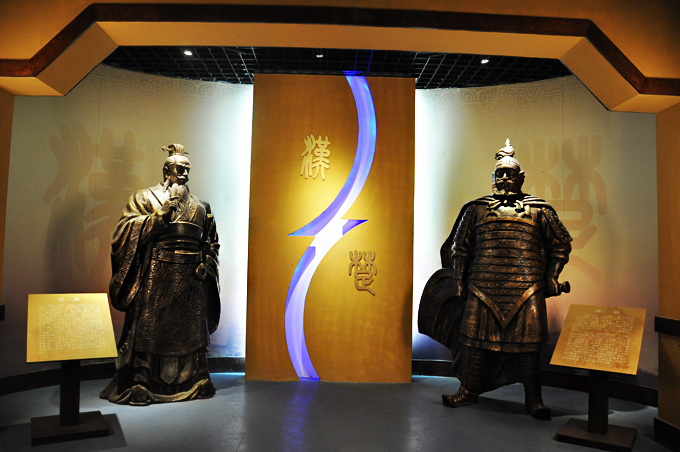
Chu-Han Contention
Overview
The Chu-Han Contention was a pivotal historic period in ancient China, lasting from 206 to 202 BC. It was a civil war that ensued after the fall of the Qin Dynasty (221-206 BC), fought between the two dominant powers: the Chu, led by Xiang Yu, and the Han, under the leadership of Liu Bang. The eventual victory of Liu Bang led to the establishment of the Han Dynasty, which lasted for over four centuries and significantly shaped Chinese civilization.
Historical Context
Following the death of the Emperor Qin Shi Huang, the harsh and tyrannical rule of his successors led to widespread unrest and rebellion. The Qin Dynasty, known for its legalist policies and significant achievements like the Great Wall of China, crumbled under internal strife and external uprising. Among the rebel leaders, two figures rose to prominence: Xiang Yu, known for his noble lineage and military prowess, and Liu Bang, a former peasant with strategic acumen and political shrewdness.
The conflict between these two leaders began in the power vacuum left by the Qin's collapse and became a struggle not just for territorial control but for the future direction of China. Xiang Yu, representing the aristocratic traditions of Chinese nobility, and Liu Bang, a symbol of emerging populist ideals and meritocracy, personified differing visions for China's future.
Major Battles and Events
The Chu-Han Contention was marked by a series of strategic battles and political maneuvers. Key battles included the Battle of Pengcheng, where Xiang Yu successfully ambushed Liu Bang, and the decisive Battle of Gaixia. It was at Gaixia that Liu Bang's forces, helped by skilled generals like Han Xin, surrounded and defeated Xiang Yu's army through a combination of deception and overwhelming force.
An iconic historical episode during the contention was the "Four Sides Song," a psychological warfare tactic allegedly used by Liu Bang's forces to demoralize Xiang Yu's troops by singing Chu songs, implying that their homeland had been captured and their families were in danger. This tactic contributed to Xiang Yu's eventual defeat and his dramatic suicide at the Wu River in 202 BC, concluding the conflict.
Cultural Impact
The Chu-Han Contention has left a significant cultural legacy, inspiring countless Chinese operas, literature, and artworks. It represents themes of loyalty, betrayal, and the human cost of ambition and power. The story of Xiang Yu and his loyal concubine, Yu Ji, has been immortalized in operatic performances like "Farewell My Concubine," which explores themes of love and loss against the backdrop of war and betrayal.
In modern times, the Chu-Han Contention continues to be a topic of interest in literature and media. For instance, contemporary works like Ken Liu's Dandelion Dynasty series draw inspiration from the historical events of this period, reimagining them in a fantastical setting to explore themes of power and identity. Article reference1. 'Under Siege' combines tradition with abstract. chinadaily.com.cn. 20192. A truly novel approach. chinadaily.com.cn. 2018Photo Gallery(8 pictures)CategoriesHistoryTagHistorical EventAncient Chinese HistoryChinese Classical LiteratureOpera and DramaRelatedXiang YuDance Drama Under SiegeCatalogue1. Overview2. Historical Context3. Major Battles and Events4. Cultural Impact- - - []








